
Kintsugi
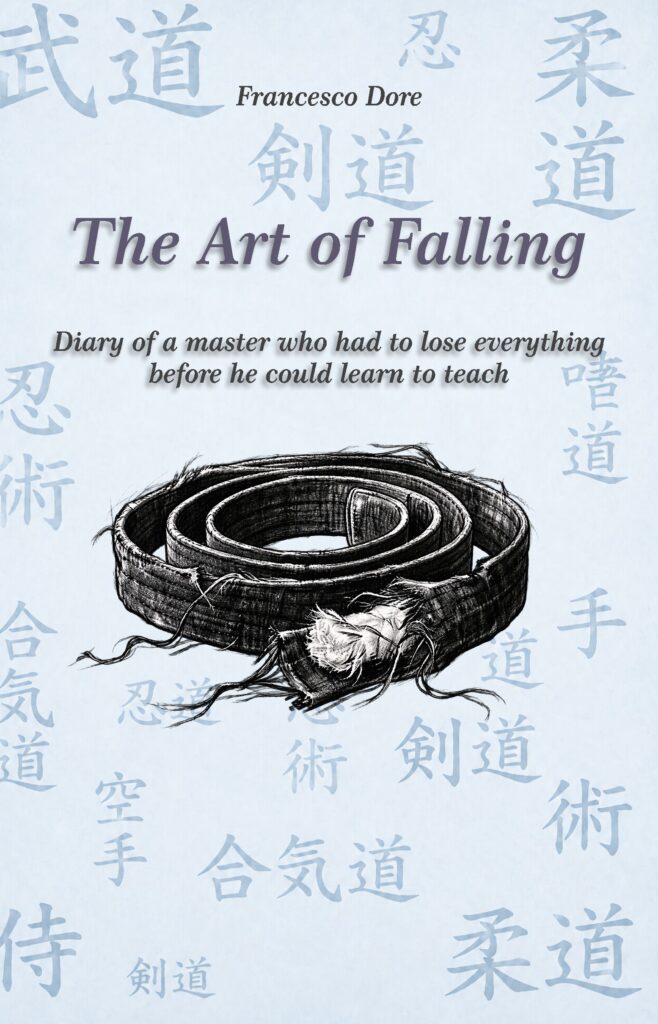
The Art of Falling
Diary of a master who had to lose every-thing before he could learn to teach
The Art of Falling is a journey through one of the most fundamental and often misunderstood principles of martial arts: learning how to fall.
Starting from ukemi, the traditional art of receiving the ground safely, the book expands the idea of falling far beyond technique. Falling becomes a way to understand balance, adaptation, fear, control, resilience and the relationship between body and mind.
This is not simply a manual on how to fall. It is a reflection on how martial practice teaches us to accept instability, transform impact and rise again with greater awareness.
The Art of Falling
Before learning how to strike, resist or overcome an opponent, there is something more fundamental to learn: how to fall.
In martial arts, falling is not merely an accident or the consequence of defeat. It is a technical act, a form of adaptation and, ultimately, a way of understanding movement itself.
The Art of Falling begins with ukemi — the traditional martial practice of receiving a fall — and gradually moves beyond its purely technical dimension. Through the study of balance, posture, rigidity, flexibility, impact, fear and adaptation, the book explores the deeper principles hidden inside an apparently simple action.
The ground is not presented as an enemy. It is a reality to which the body must learn to respond.
A rigid structure resists until it breaks. A flexible structure absorbs, redirects and adapts. In the same way, effective ukemi is not based on opposing force but on understanding it, accompanying it and distributing it through movement.
From this perspective, falling becomes a laboratory in which many of the essential principles of martial arts can be observed: the relationship between tension and relaxation, strength and technique, control and surrender, ego and learning.
The book also examines the psychological dimension of falling. Fear changes posture, contracts the body and often creates precisely the conditions that make an impact more dangerous. Learning to fall therefore also means learning to recognise fear without allowing it to govern movement.
But The Art of Falling is not intended only as a technical study of martial arts.
Its central idea reaches further.
Every fall contains a transition: a loss of balance, an encounter with something that cannot be avoided, and the necessity of adapting to a new condition. Martial practice teaches that the objective is not always to prevent the fall. Sometimes the real skill lies in knowing how to enter it, how to pass through it and how to rise from it.
For this reason, the art of falling is also an art of continuity.
The practitioner does not train never to fall.
The practitioner trains so that falling is no longer the end of movement.
Live mirror of books.effedore.com
Available formats
Available formats
01 · What is inside the book
Contents
The complete structure of the published volume.
Table of Contents
- Prologue: The Art of Losing Your Balance
- Introduction.
- The Paradox of the Closed Door
- The School — The Perfect Aquarium..
- The Philosophy of the Punch — Between Mysticism and Biomechanics
- The Rebel Student - The Virus in the System..
- The Roots - the Anatomy of an Error
- The Test - the Aquarium and the Ocean.
- Betrayals and Secrets - Pandora’s Box.
- The Fall — The Art of Hitting the Bottom..
- The Rebuilding — What Is Essential Is Invisible to the Eye
- The Alignment — The Dojo of Concrete and Rust
- The Confrontation — The Noise and the Silence
- The Lesson — The Danger of the Summit
- New Beginnings — The Open Source Dojo.
- Epilogue.
- Appendix A..
- Dramatis Personae — Biographies and Narrative Arcs
- Appendix B..
- Appendix C..
- Author’s Afterword.
- Acknowledgements.
- Disclaimer
- Contact
02 · Read before buying
Extracts
Selected passages available directly from the master catalogue.
01Prologue: The Art of Losing Your BalanceOpen extract
People often ask me what it means to be a black belt. They expect the answer from the manual, the one padded out with Eastern mysticism and motivational rhetoric: it means perseverance, it means invincibility, it means you have reached the top of the mountain. For years I gave them that answer. I sold them the illusion that the black cloth tied around my waist was a magic armour against the uncertainties of the world. I was lying. Not out of malice, but out of necessity — the same necessity that makes a parent tell a child there are no monsters under the bed, even while the parent himself, in the dark, can hear them breathing. Today I am sitting on a wooden crate in a place that smells of engine oil and damp, light years from the polished parquet and the spotless walls where this story began, and I know the true answer. Being a black belt does not mean you have stopped falling. It means you have lost the shame of falling. It means you have understood that the floor — fine timber or raw concrete, it makes no difference — is not an enemy to be kept at a distance. It is the one partner that never lies, the one that always holds you up, provided you agree to come down to its level. …
02Chapter Nine The Alignment — The Dojo of Concrete and RustOpen extract
Part One: The Geometry of a Narrow Space
Luca’s uncle’s garage is a rectangular den of barely thirty square metres that stinks of used engine oil, mould laid down in layers over the years, and abandoned dreams. There are no windows, only a rusting roller shutter that jams halfway up, letting a blade of dirty light in from below, and a single incandescent bulb, bare and yellowish, hanging from the ceiling and swinging like a hypnotist’s pendulum every time somebody slams the side door. For a teacher accustomed to polished maple, a filtered ventilation system and a sacred alcove, a tokonoma, with fresh flowers changed every morning, this place ought to be a nightmare of hygiene and taste. Instead, against all my snobbish expectations, it turns out to be a revelation.
We spent the first week not training but clearing out. In Japanese it is called soji, the ritual cleaning, an act supposed to purify the spirit through care of the space. But this was not a matter of passing a damp cloth over sacred dust in monastic silence. It was a physical battle against accumulation. We shifted old washing-machine motors as heavy as boulders, stacked mouldering car magazines from 1980, and scraped decades-old grease stains off the raw concrete with scrapers and chemical solvents that made our eyes stream. In that dirty work I watched the group align itself better than it had in a thousand hours of formal lessons. Arturo, whose knotted arthritic hands struggle to close into a fist, turned out to be a genius of improvised mechanics. He repaired the shutter spring with a piece of wire and a great deal of patience. He built a rack for the sticks out of scrap PVC plumbing pipe, turning rubbish into infrastructure. Giulia, who in the old Dojo grew bored if a theoretical explanation ran past two minutes, spent three hours scraping rotten plaster off a wall and found in that repetitive, furious action a form of moving meditation, mushin, that no kata had ever given her. And Luca … Luca took possession of the space. He was no longer the shy guest or the frightened student. He was the host, opening the doors of his kingdom to his clan.
Once the space was clear, we ran into the insurmountable technical problem: the garage is small. And it has two reinforced concrete pillars right in the middle of it. My old method, made of wide circular movements and long-range throws that need metres of space for the fall, is physically inapplicable here. Take too long a step in a lunge and you crack your knee on the workbench. Swing your arms into a wide block and you split your knuckles on a pillar. The architecture imposed the teaching, with a violence there was no appealing against. I had to shorten the martial art. I had to amputate the superfluous. No more high circular kicks, which we never loved anyway but sometimes did as stretching. No more wide evasions. No more safe distance. Here the law of close quarter combat applies. Very short range. The enemy is on top of you. The wall is at your back. There is no escape route, there is only the management of panic.
Edizioni Effedore

Francesco Dore
Francesco Dore è autore e ricercatore indipendente. Il suo lavoro nasce dall’incontro tra esperienza professionale, studio dei sistemi di gestione, hotellerie e ricerca applicata. Nei suoi libri utilizza un approccio basato sull’analisi dei processi, sul confronto delle fonti e sull’osservazione delle conseguenze reali delle decisioni organizzative.