
The Helm and the Lens
The Helm and the Lens – volume 3a
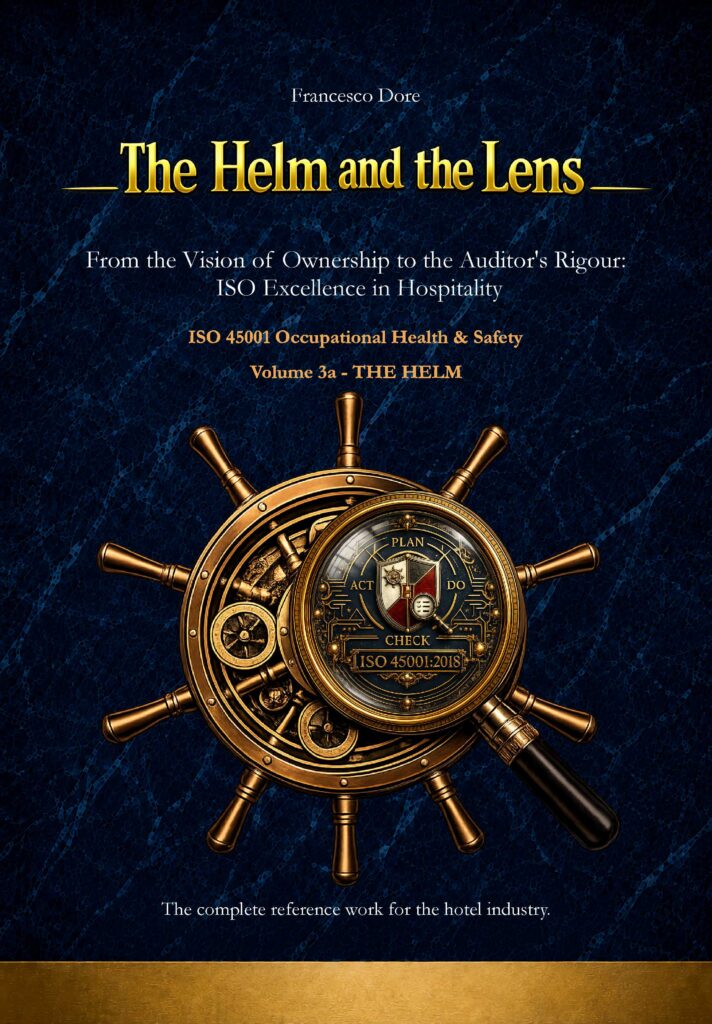
ISO 45001 Occupational Health & Safety Volume 3a — The Helm
A hotel can be rebuilt after fire and reopened after closure. It cannot undo what happens to a person inside it. ISO 45001 followed through a working hotel — thirty subchapters, thirty cities, from the owner's desk to seven in the morning.
Volume 3a of The Helm and the Lens takes the position of the people who decide before anyone is hurt: owners, general managers, heads of department, and the coordinators who inherited a safety system from somebody who left.
It follows ISO 45001 through a building that never closes. The first chapter stays with ownership — context, who counts as a worker, the boundary of the property, the duty that cannot be delegated, consultation, hazard identification, objectives, competence and communication. The second goes to the floor: operational control at seven in the morning, the hierarchy of controls, change, contractors, permits, handover, emergencies, incidents, reprisal, fatigue, and what remains when the people who built the system have gone.
Thirty subchapters, thirty properties, thirty cities. An evacuation where two hundred and fourteen names on the list meet three hundred and one people at the assembly point. A committee whose minutes record, month after month, that no matter was raised from the floor. A first aid register holding sixty-three treatments, none of which reached the figure reported to the owners.
In almost none of those cases did anybody do anything wrong. That is what this book keeps arriving at: the harm sits in the seam between two people who were both doing their jobs correctly, and the fact that would have revealed it was already in the building, filed by somebody who did not know what they were holding.
Every subchapter carries a Guiding Question the reader can answer in their own property today, the requirement stated in the book's own words, and the Verification Pact — a claim commonly made in the market, set against what the requirement actually holds.
It is not consultancy. It sells no template and no checklist, and it will not tell you whether your property is compliant. What it offers is narrower and more useful: how to find out, in your own building, at the hour when it matters.
493 pages · thirty concept cards · glossary · analytical index
Live mirror of books.effedore.com
Available formats
Available formats
01 · What is inside the book
Contents
The complete structure of the published volume.
Table of Contents
- Preface.
- 1.1 The Asset of Human Integrity.
- 1.2 The Geography of Harm...
- 1.3 Who Counts as a Worker.
- 1.4 Interested Parties Without a Jurisdiction.
- 1.5 Scope and the Boundary Problem...
- 1.6 Leadership and the Duty That Cannot Be Delegated.
- 1.7 Consultation and Participation: Removing the Obstacles.
- 1.8 Hazard Identification as a Continuous Act.
- 1.9 Risks, and the Opportunities Nobody Files.
- 1.10 Compliance Obligations Without a Jurisdiction.
- 1.11 Objectives and the Indicators That Predict.
- 1.12 Resources: Budgeting for Protection.
- 1.13 Competence, Awareness and the Seasonal Intake.
- 1.14 Communication: What Has to Travel, and to Whom...
- 1.15 The Competitive Advantage.
- 2.1 Operational Control: the System at Seven in the Morning.
- 2.2 The Hierarchy of Controls.
- 2.3 Management of Change.
- 2.4 Procurement, Contractors and Outsourcing.
- 2.5 Permit to Work: Controlling the Dangerous Task.
- 2.6 Handover: What Has to Cross the Shift Line.
- 2.7 Documented Information at the Point of Use.
- 2.8 Emergency Preparedness and Response.
- 2.9 Monitoring, Measurement and the Safety Walk.
- 2.10 Evaluation of Compliance.
- 2.11 Incident, Nonconformity and Corrective Action.
- 2.12 Reporting Without Reprisal
- 2.13 Management Review at the Board Table.
- 2.14 Fatigue, Workload and Psychological Health.
- 2.15 Continual Improvement, and the Helm and the Lens.
- Afterword.
- Sources and Research Methodology.
- Glossary.
- About the Author.
- Contact.
- The Series.
- The Online Platform...
- Acknowledgements.
- Analytical Index.
02 · Read before buying
Extracts
Selected passages available directly from the master catalogue.
01PrefaceOpen extract
A management system is built by people trying to make something happen. It is verified by people trying to find out whether it did. Those are different skills, and much of what goes wrong in the second act happens because it was attempted with the vocabulary of the first.
In occupational health and safety the distance between the two is not academic. An environmental control that fails quietly produces a figure that was never true, and the cost of finding out late is money and credibility. A safety control that fails quietly produces a person in an ambulance, and the cost of finding out late has already been paid by someone who did not choose to pay it. The verification is the same discipline. The consequence of skipping it is not.
Volume 3a built the system from the position of the people who own the property and run it. This volume examines the same system from the two positions that have to be convinced it works: the internal auditor, who has to keep coming back and living with what they wrote, and the certification body, which arrives for a few days and signs. Neither of them builds anything. Both of them decide whether what was built is real.
Who this book is for
The coordinator who inherited a safety system from someone who left. The chief engineer told to audit a discipline nobody asked whether they had been trained to audit. The human resources manager holding four hundred training records and no way of knowing which of them describe competence. The general manager who signs the policy and will sit across from the certification auditor. And the owner or asset manager who decides whether the certificate is a line worth keeping.
Three facts about hotels govern everything in this book. The first is that a hotel is not a fence around a process. It is a bundle of contracts around an address: the laundry may belong to someone else, the kitchen may be run by a concession, the night cleaning may arrive at eleven from an agency the duty manager has never met. The second is that the building runs twenty-four hours in an industry that is managed between nine and six, so the conditions most worth examining occur when the people who would examine them are asleep. The third is that a great deal of the work carrying the highest exposure is done by people who will not be there next season, often reading procedures written in a language that is not their first.
To these the standard adds a fourth, and it is the one that separates this discipline from the others in the series. The system is required to be built with the participation of workers and to consult them about it. That obligation falls on precisely the people who have the least standing to refuse a shift, the least security in the contract and the most to lose by being difficult. Every chapter of this book eventually returns to that asymmetry, because every method in it depends on somebody being willing to say something inconvenient.
What this book is, and what it is not
It is a practitioner’s guide to verifying an occupational health and safety management system in a hotel. It is not consultancy, it does not sell a template, and it will not tell you whether your property is compliant — nobody who has not stood in your plant room at six in the morning can tell you that. It is also not a collection of forms. More documentation is not more safety, and a property can be buried in paper and still be dangerous in the four places that matter.
Where the book states what is required, it states it as a requirement. Where it recommends a method, it says that it is a method, and that other methods will do. The distinction is kept visible on the page rather than in a footnote, because the difference between the two is exactly what an auditor is paid to see.
The four fixed elements
Every subchapter carries the same four. A Guiding Question opens it, and is the question the subchapter exists to answer. What the Standard Says sets out the applicable requirement in the book’s own words, never in the standard’s. The Verification Pact runs a claim commonly made in the market against what actually holds, which is the discipline the whole series is built on. Objective Evidence closes the practical section with what would actually demonstrate the thing: what document, what record, what observation, what interview, what re-performance — and, in every case, what will not be there. That last line is deliberate. A book that spends thirty subchapters arguing against checklists cannot end each one with a checklist. …
021.15 The Competitive AdvantageOpen extract
1.15 The Competitive Advantage
GUIDING QUESTION An owner asks what this is going to get her. Answer without a percentage, without a multiplier and without promising that nobody will be hurt — and notice how much is left.
Opening
Giulia Depangher had the 1974 file on the desk again, and beside it three decisions that had nothing to do with 1974 at all.
The first was a tender. A shipping group with offices along the Rive had put its Trieste accommodation out to competition and the pre-qualification carried nineteen questions about how the hotel looks after the people who work in it. The second was a refurbishment: the fourth floor, quoted, scheduled for the following winter, with the service stair excluded from the scope as it had been excluded from every scope since 1961. The third was a list her rooms division manager had put in front of her without comment — the seasonal team from the previous summer, with a mark against each name showing who had come back. Nineteen of forty-one.
The file from 1974 concerned a porter, a lift shaft and a settlement, and it was the reason her father had kept it. She had opened this chapter with it because it had struck her, the first time she read it, that it was the only document in the archive from that year that anybody still read. The invoices were gone. The rate sheets were gone. The correspondence about the 1974 refurbishment had been thrown out during the 1998 one. What the property had carried across five decades, in a folder, in a language nobody in the building now spoke, was an account of the day it had hurt somebody.
And the question she asked at the end of the process this chapter has described was the one every owner asks, and she asked it plainly, because she is not a woman who asks things obliquely. What does this get me.
The Problem
The industry answers that question badly in both directions, and the two bad answers do roughly equal damage.
The first bad answer is the moral one delivered without arithmetic — that nothing matters more than people, that safety is a value rather than a cost, that the question itself is slightly improper. It is sincerely meant and it does not survive a budget meeting. An owner who has heard it three times learns that the safety function cannot make a case, and stops asking, which is worse than the argument being lost.
The second is the promise of a return, dressed in figures nobody can support. Somewhere in the industry’s literature a ratio circulates — every unit spent on prevention returns some larger multiple — and it is repeated in presentations by people who could not say where it came from or what it was measured on. It wins the meeting and it loses the following year, when the return does not appear in any account the finance director can find. A property that has been sold a multiplier and has not received one becomes considerably harder to persuade about anything else.
And underneath both sits a problem this book has to face at the end of its first chapter, because it is a problem of honesty rather than of technique. The return on a safety system cannot be calculated. The counterfactual is unobservable: nobody can know what would have happened in the version of the year in which the trolley was not replaced, and the events being avoided are rare enough that a single hotel will never generate enough of them to measure anything. Any figure claiming otherwise is comparing hotels that chose to do this with hotels that did not, and the choosing is not random.
The Principle
There is an honest answer to the owner’s question and it has four parts, none of which is a percentage.
The first is access, and it is the only part that can be counted before anything happens. A share of a hotel’s revenue arrives through doors where somebody asks about this and checks the answer — corporate accommodation programmes, meetings and events business, institutional frameworks, group and operator agreements. That share is in the sales system and it takes two days to extract, as 1.4 established. It is not an argument that safety pays; it is a statement about which part of the business is exposed to a question the hotel currently cannot answer. At the Rive it was the nineteen questions on the desk.
The second is labour, and in hospitality it is the argument that reaches an owner faster than any other because it is already on her mind. Nineteen of forty-one is a recruitment cost, a training cost and a competence cost repeated every summer, and it is also — as 1.13 established — the mechanism by which a property concentrates its exposure in the least prepared population it has. A hotel that people come back to is cheaper to run and safer at the same time, and the two are the same fact rather than two facts that happen to correlate. What a seasonal worker remembers about a property is not its policy. It is whether the person who asked her to do something dangerous took no for an answer.
The third is continuity, and it is the one an operator feels and an owner rarely sees. An injury in a hotel is not a line in an insurance account; it is an operational event. It removes a person from a department that has no spare capacity, it consumes a manager’s week, it can close a floor or a kitchen or a lift, and it arrives without regard to occupancy. The property is not buying a reduction in claims. It is buying a smaller number of weeks in which the operation is doing something other than operating.
And the fourth is the one that answers the file from 1974, and it is about what an owner actually owns at the end of all this. It is not the certificate. The certificate is a receipt. What the property owns is a set of capabilities that did not exist before: it knows where its harm concentrates, it knows who is working in its building and under what arrangement, it knows what it is obliged to do and by whom, it has a route by which the people who see a hazard can reach the person who can remove it, and it has a record of what happened and what was done. Those things are worth something in a tender, in a due diligence, in front of an investigator and in the corridor at two in the morning — and unlike a certificate they do not lapse on a date.
What the standard itself claims is narrower than any of this, and a book that overclaims where the standard does not would be a poor guide. Its stated intended outcomes are the continual improvement of health and safety performance, the fulfilment of legal and other requirements, and the achievement of the organisation’s own objectives. And it says, in its own introduction and without hedging, that adopting it will not guarantee the prevention of work-related injury and ill health, nor safe and healthy workplaces, nor improved performance. That sentence is the most credible thing in the document, and it is the sentence a hotel should repeat to its own people rather than hide from them.
Because the promise a property can actually keep is a different and smaller one, and it is the right one to make. Not that nobody will be hurt. That when something happens it will be found, it will be answered, and it will not happen the same way twice — and that the person it happened to will not pay for having said so. …
Edizioni Effedore

Francesco Dore
Francesco Dore è autore e ricercatore indipendente. Il suo lavoro nasce dall’incontro tra esperienza professionale, studio dei sistemi di gestione, hotellerie e ricerca applicata. Nei suoi libri utilizza un approccio basato sull’analisi dei processi, sul confronto delle fonti e sull’osservazione delle conseguenze reali delle decisioni organizzative.